Local ground
Why foundations move in Sugar Land
The short answer is clay. Sugar Land is built on two kinds of it, and both change size with the weather. A slab does not sit on rock here. It floats on soil that swells when wet and shrinks when dry.
What is under a Sugar Land slab
The layer that matters is the top several feet of clay, sometimes called the active zone. It gains and loses water through the year, and its volume follows.
Under the middle of the house the clay is sheltered and stays fairly constant. Around the edge it is exposed to sun, roots and rain. So the edge of a slab rides up and down more than the middle, and that difference is what cracks brick.
Prairie clay
Much of the coastal prairie between the Colorado and Trinity rivers is covered by clay soils laid down as the Beaumont Formation. The federal soil survey's description of one of the most widespread, the Lake Charles series, reads like a list of foundation problems.
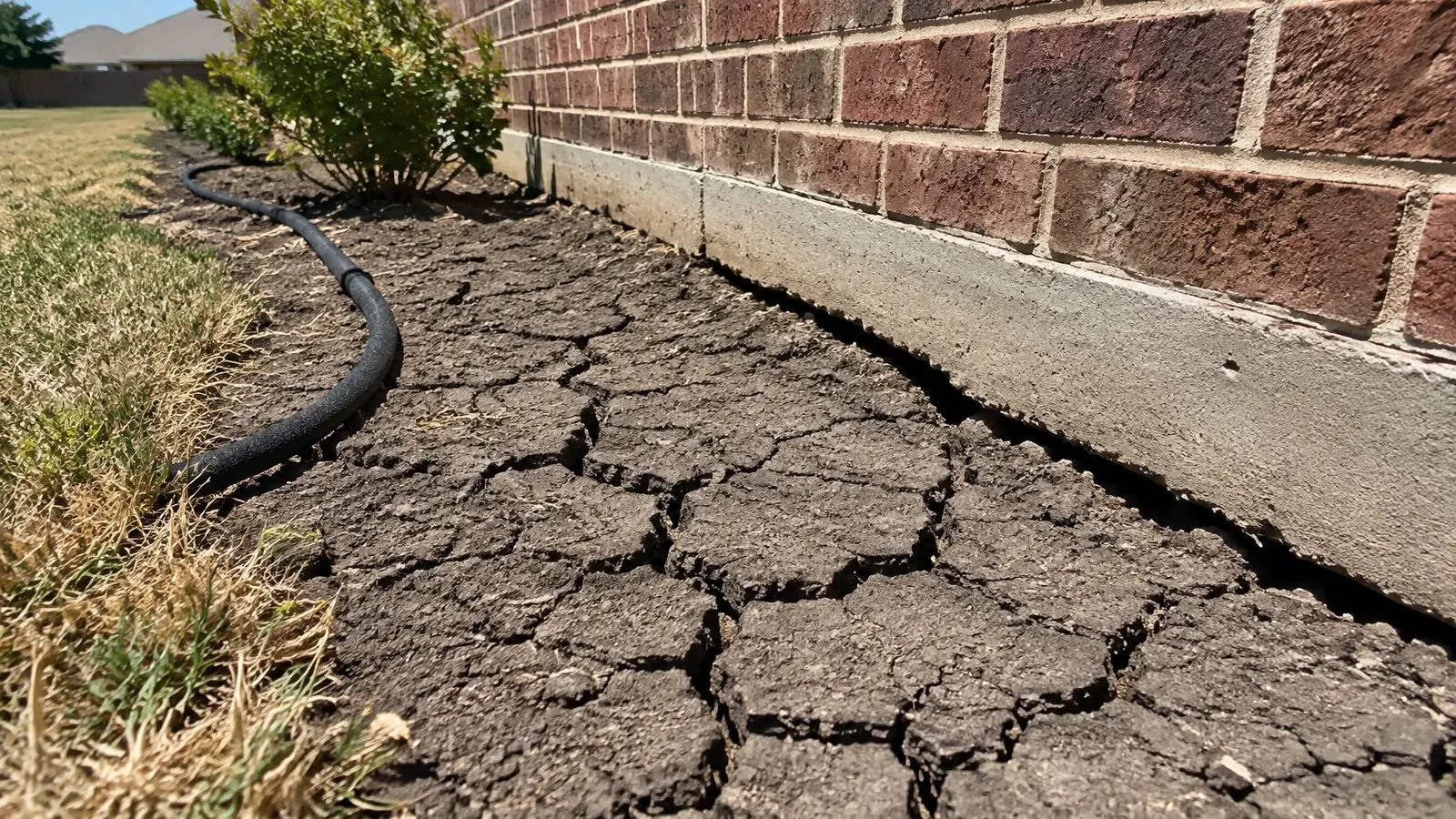
When it dries, it opens cracks from half an inch to two inches wide at the surface that reach a foot or more down. In most years those cracks stay open for two to three months in total. Water pours in while the cracks are open and hardly soaks in at all once the clay has swollen shut.
For a house, that means two things. The gap that opens between your lawn and your slab in August is the clay letting go of the beam. And the first big rain after a drought goes straight down those cracks to the soil beside and under the edge of the foundation.
River-bottom clay
Toward the Brazos River the ground has a different origin: mud left by the river in flood over thousands of years. The soil survey maps clays such as the Brazoria series on the Brazos flood plain, and describes them as very deep and very slow to let water through.
The behaviour under a house is much the same. Both are heavy clays that move with moisture. If you are curious which soil is mapped at your address, the Web Soil Survey will show it. A repair company cares less about the name than about how deep it has to go to find soil that pushes back.
A year in the life of a slab
Late spring
The clay is moist from winter and spring rain and close to its full size. Some moisture-related changes may ease. Record whether doors and cracks change.
High summer
Weeks of heat pull water from the soil around the perimeter. The soil at a slab edge can shrink and provide less support.
First heavy rains
Water runs down the shrinkage cracks. The edge clay swells again, though rarely evenly on all four sides.
Year after year
Repeated cycles can affect the support beneath a slab. After a long drought the change can be large enough to see in the brick.
Three things that make one house worse than the next
Trees
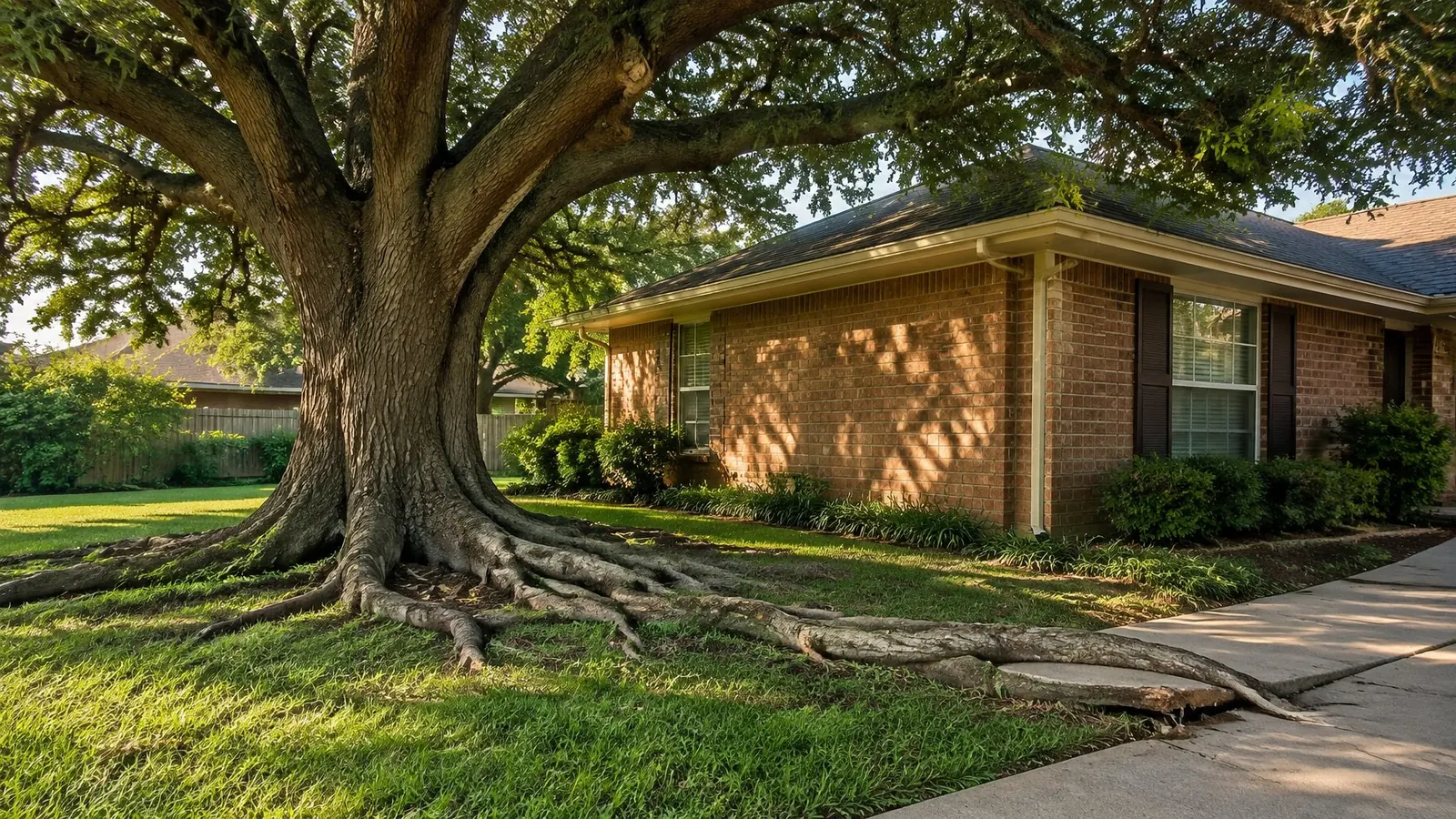
A mature live oak takes a great deal of water from the soil through summer. Clay near its roots dries faster and deeper than the clay on the far side of the house.
Leaking pipes
A drain or supply line that leaks under the slab keeps one patch of clay wet all year. That patch swells while the soil around it follows the seasons.
Where the rain goes
Downspouts, flat yards and raised beds decide which side of the house stays wet. See water pooling by the house.
Subsidence is something else
You will hear the word subsidence in Fort Bend County. It means the gradual sinking of the land over a wide area as groundwater is pumped out and the fine sediments deep in the aquifer compact. The Fort Bend Subsidence District, set up by the Texas Legislature in 1989, regulates groundwater pumping in the county to limit it.
The District's concern is flooding and drainage on very flat land. It describes subsidence rates in the county as moderate and publishes a map of measured changes.
Subsidence lowers whole neighbourhoods slowly and together. A crack that opens on one side of one house still needs an inspection. Drying clay, a tree, a leak and drainage are possibilities for the foundation inspector to examine alongside wider ground conditions.
Slabs, cables and older houses
Most houses in Sugar Land's subdivisions stand on a concrete slab poured on the ground, stiffened by beams cast into its underside. Many are post-tensioned, and the city requires an engineer's seal on post-tension designs for new houses and additions.
A stiffened slab is designed to ride the clay as one piece. It copes with ordinary seasons. It struggles when one side stays much wetter or drier than the other for a long time.
A smaller number of older houses stand on piers above a crawl space. They move differently and are repaired differently: see pier and beam foundation repair.
Questions about the ground here
Is one part of Sugar Land worse than another?
The differences between two lots on the same street are usually bigger than the differences between neighbourhoods. The age of the slab, the trees, the drainage and any plumbing leaks decide how a particular house behaves.
Do newer houses avoid the problem?
Newer slabs are engineered for expansive clay, which helps. The clay under them still shrinks and swells, so drainage and even moisture matter for a five-year-old house as much as for a fifty-year-old one.
When you are ready
Describe the problem and book an inspection
One call puts you in touch with an independent foundation repair company that works in Sugar Land. Have the address, the age of the house and a short list of what has changed.
Talk to a local foundation company
Say what you are seeing and where in the house. The company you reach is independent and gives you its own findings and its own price.
Call (832) 307-1056Read the referral disclosure and the privacy policy.