Warning sign
Sloping, dipping or uneven floors
You feel it before you see it: a slight downhill walk toward the back wall, a cabinet door that swings open, a chair that will not sit still.
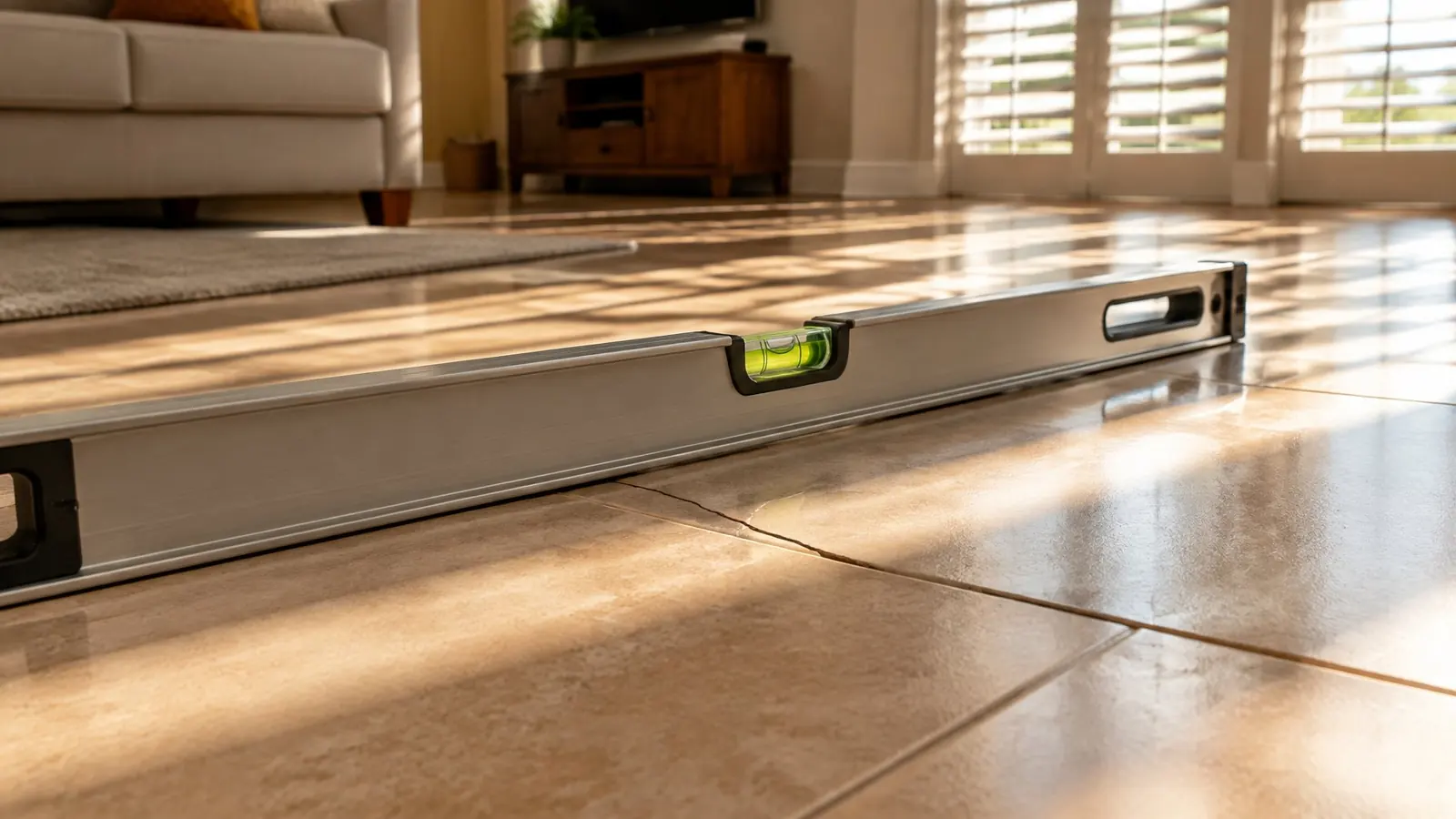
What people notice
- A marble or a ball rolls the same direction every time.
- Tile cracks in one continuous run across a room, sometimes through the doorway into the next.
- A gap opens between the baseboard and the floor along one wall.
- Furniture leans, or a bookcase stands away from the wall at the top.
- A ridge or a shallow bowl in the middle of a large room.
On a slab, a tilt toward an outside wall can mean that edge has gone down. A hump in the middle can mean the edges dropped or the centre rose. Those are different problems with different remedies.
Things that are not the foundation
The slab was never flat
Concrete is finished by hand to a tolerance. Many sound slabs are slightly out from end to end and have been since the day they were poured.
The flooring itself
Laminate and wood planks cup when moisture gets under them. Tile can lift in a tent shape when it has no room to expand.
Upstairs floors
A dip in a second-storey floor can involve the framing between the storeys. Ask an engineer to establish whether the framing, the foundation or both need attention.
How a floor is measured
The person inspecting sets a reference point, usually near the middle of the house, and takes height readings every few feet with a digital levelling instrument. Readings are adjusted for carpet, tile and wood, which sit at different heights.
The result is a sketch of the floor plan with a number at each point. High and low areas show up as a shape: a tilt, a dish or a dome. Ask for a copy.
One survey shows the shape of the floor today. It cannot show whether the floor is still moving. If you have a survey from when the house was bought, or one from a previous repair, find it. Two sets of readings a year apart say far more than one.
What repair can and cannot do
Where an edge has dropped, piers under the perimeter beam can raise it. Low spots away from the edge are sometimes lifted by pumping grout or expanding foam under the slab. Both are described in the repair methods guide.
A lifted slab is brought back toward where it started, as far as the structure will go without new damage. That is seldom perfectly level, and a careful company says so before work starts.
Questions about floors
How much slope is too much?
There is no single number that fits every house. An engineer weighs the size of the tilt against its shape, the damage that goes with it and whether it is changing. A small tilt with fresh cracks can matter more than a larger one that has not moved in twenty years.
Can I check the floor myself?
A four-foot level and a tape measure will show a tilt across a room, and photos of the bubble are useful on a call. They will not replace a full set of readings across the whole slab.
When you are ready
Describe the problem and book an inspection
One call puts you in touch with an independent foundation repair company that works in Sugar Land. Have the address, the age of the house and a short list of what has changed.
Talk to a local foundation company
Say what you are seeing and where in the house. The company you reach is independent and gives you its own findings and its own price.
Call (832) 307-1056Read the referral disclosure and the privacy policy.