Warning sign
House leveling in Sugar Land
In Texas, raising a foundation that has settled is called house leveling. The name promises a little too much. The aim is to bring the low part back toward where it began and keep it there.
Signs that one side has dropped
Settlement on one side leaves a trail that agrees with itself. The brick on that side has stair-step cracks. The trim under the eaves has pulled away from the brick. Doors along that wall lean toward it. A ball on the floor rolls that way.
A chimney is heavy and sits on the edge of the slab, so it is often the first thing to tip. A gap you can see daylight through between chimney and wall belongs on your list. So does a porch or a set of steps that has come away from the house.
Why one edge and not the whole house
The edge dries first
Soil under the middle of a slab is sheltered. Soil at the perimeter bakes in summer, shrinks and stops holding the beam up, most of all on the south and west sides.
A thirsty tree
A large oak close to one corner draws moisture from the clay beneath that corner through every dry month.
Water in one place
A downspout or a leaking pipe that soaks one area can make the clay there swell and push up. The house tilts, but the high side is the problem.
Dropped or pushed up: it matters
A slab that is low on the east and a slab that is high on the west look the same from the sofa. They are not repaired the same way. Piers hold up an edge that has sunk. They do nothing for a section that swelling clay has lifted, where the remedy is to deal with the water.
A floor height survey, described on the floors page, is how the two are told apart. Ask the company which one it believes you have and why.
What usually happens on the job
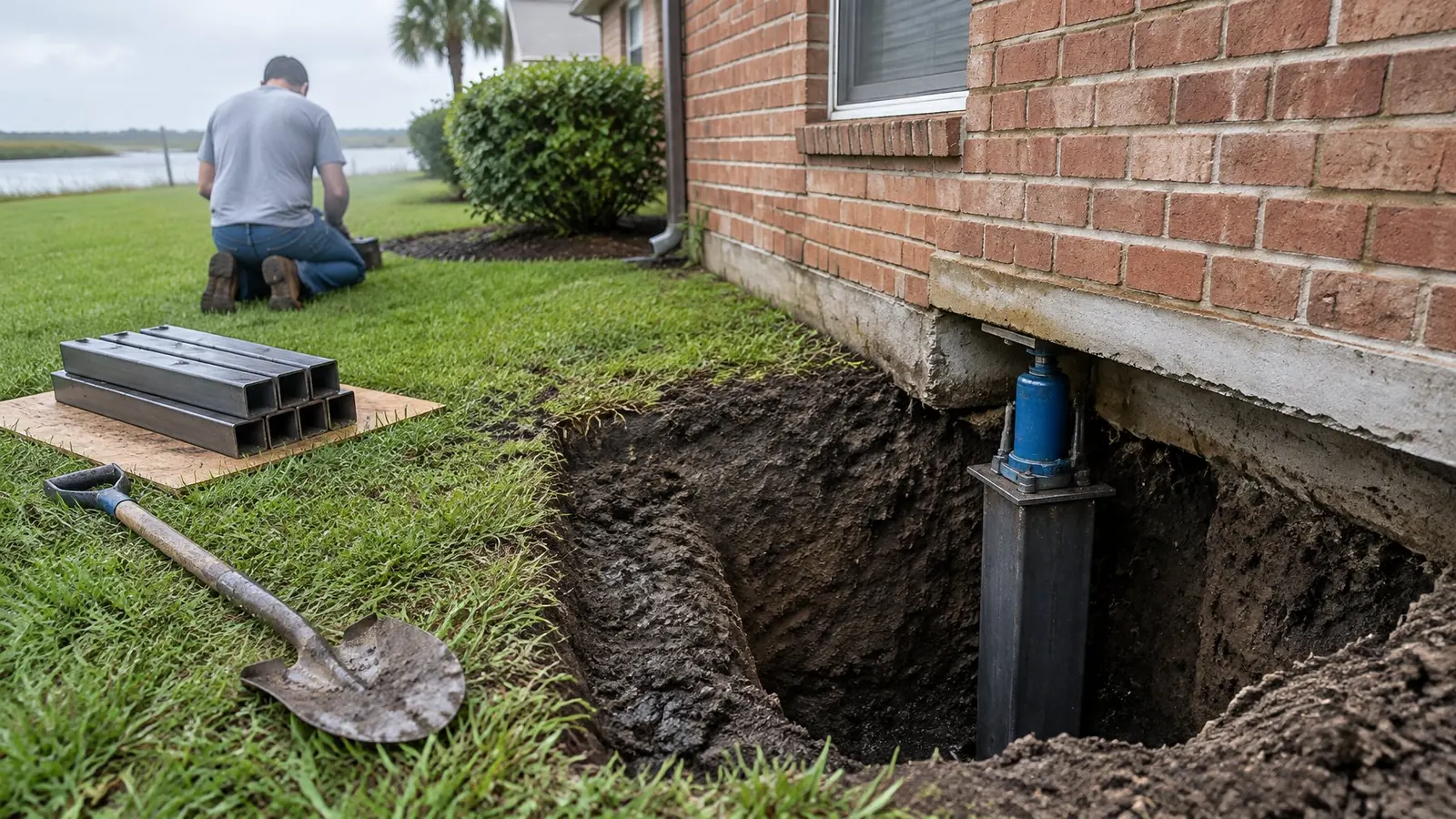
Holes at the pier points
Small pits are dug beside or under the perimeter beam at the spacing shown on the plan. Shrubs in the way are lifted out and set aside.
Piers go in
Steel or concrete sections are pressed down under the beam, or shafts are drilled and filled, until they reach soil that resists.
The lift
Jacks on the piers raise the beam in small steps while someone watches the cracks, the doors and the readings indoors.
Lock off and backfill
Shims or brackets hold the new height, the holes are filled and the plants go back. Interior piers mean opening the floor or tunnelling under it.
Ask before you sign
- A drawing showing every pier and its spacing.
- How deep the piers are expected to go, and what happens to the price if they go deeper or stop short.
- Whether an engineer has reviewed the plan, and whether you get the engineer's letter.
- Who applies for the city permit.
- A plumbing pressure test after the lift, because raising a slab can strain old drain lines.
- Which repairs to brick, drywall, tile and landscaping are included.
- The warranty in writing: what it covers, for how long, and whether it passes to a buyer.
The guide to choosing a company goes through these one by one.
Questions about leveling
Do we have to move out while the house is raised?
That depends on the method and on where the piers go, so it is a question for the company doing the work and for the engineer if one is involved. Ask it before you agree a start date.
Will the house be perfectly level afterwards?
Rarely. A slab that has been out of position for years has a frame, brick and pipes that adapted to it. The lift stops when going further would do more harm than good.
Is leveling a pier and beam house different?
Yes. The work is done from the crawl space with shims, new piers and sometimes new beams. It has its own page: pier and beam foundation repair.
When you are ready
Describe the problem and book an inspection
One call puts you in touch with an independent foundation repair company that works in Sugar Land. Have the address, the age of the house and a short list of what has changed.
Talk to a local foundation company
Say what you are seeing and where in the house. The company you reach is independent and gives you its own findings and its own price.
Call (832) 307-1056Read the referral disclosure and the privacy policy.