Warning sign
Foundation crack repair
Most of a slab is hidden under flooring, so cracks in the concrete itself turn up in the garage, along the exposed edge below the brick, or on the day the carpet comes up.
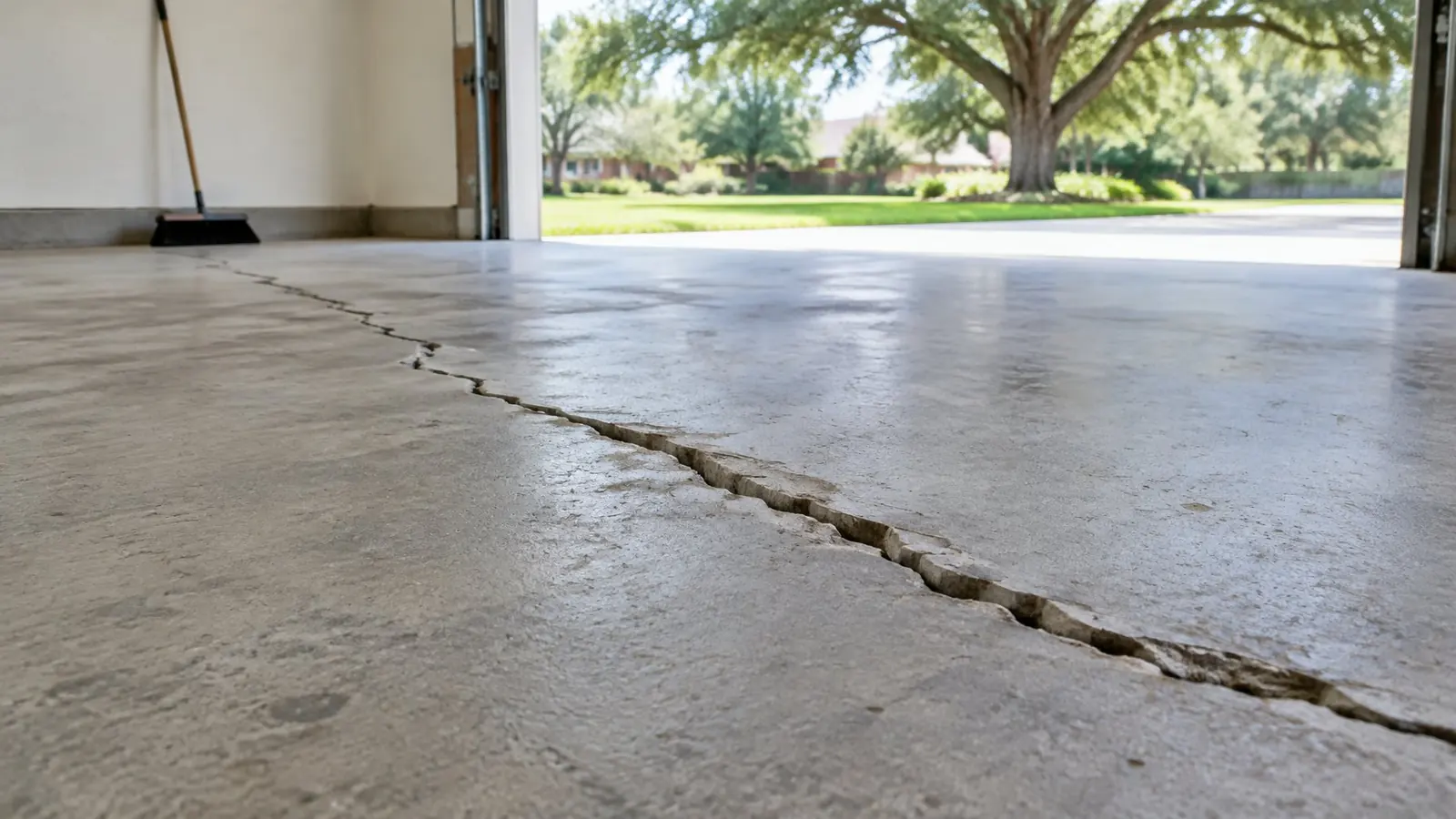
Four kinds of slab crack
Hairline shrinkage cracks
Thin, wandering lines can form while concrete cures. Record their width and whether both sides are level. An inspector considers these details alongside other signs before identifying the cause.
Cracks with a step
One side stands higher than the other, or the crack is wide enough to take a coin. This suggests the two parts of the slab have moved relative to each other.
Corner wedges
A triangular piece can crack off the outside corner of the slab under the brick. Different movement of the brick and concrete is one possible cause. Have the inspector examine it rather than judging its significance from its shape alone.
Cracks in flatwork
Driveways, walks and patios are separate pours that float on the soil. Their cracks say something about the ground but are not cracks in the house foundation.
What gets checked
- Width along the crack, and any height difference across it.
- Whether the crack lines up with cracked tile or a wall crack above it.
- Floor heights on both sides, to see if one part of the slab has tilted.
- The exposed slab edge all the way round the house.
- Signs of an under-slab plumbing leak, such as a warm patch or an unexplained water bill.
- Rust stains, which can mean water is reaching the steel.
How cracks are repaired
A crack that is not moving can be sealed. Epoxy injection bonds the two faces together. A flexible polyurethane filler keeps moisture and insects out. Neither one stops a slab that is still shifting, and a crack sealed over active movement will usually open again beside the repair.
If the measurements show that part of the slab has dropped, the crack is a symptom and the repair is to the support under the slab. See house leveling.
If a pressure test finds a leaking drain or supply pipe under the slab, a licensed plumber repairs that first. Wet soil from a leak can lift or soften the ground in one spot, and lifting the slab before the leak is fixed solves nothing.
Questions about slab cracks
I pulled up the carpet and found a crack. Should I worry?
Not on that alone. Measure its width in a few places, lay a straight edge across it to see whether one side is higher, and take photos. A thin crack with level sides is very common. A stepped or widening one is worth an inspection.
Does water come up through slab cracks?
Seldom here, because slabs sit above the surrounding ground. Dampness at a crack more often points to a plumbing leak below. Sealing basements against groundwater is a separate trade, and houses here are rarely built with basements.
Can I seal a crack myself?
A hairline crack in a garage floor can be filled with a concrete crack sealant from a hardware store. Photograph and measure it first, so there is a record if it grows.
When you are ready
Describe the problem and book an inspection
One call puts you in touch with an independent foundation repair company that works in Sugar Land. Have the address, the age of the house and a short list of what has changed.
Talk to a local foundation company
Say what you are seeing and where in the house. The company you reach is independent and gives you its own findings and its own price.
Call (832) 307-1056Read the referral disclosure and the privacy policy.