Warning sign
Cracks in brick, walls and ceilings
Brick veneer and drywall are stiff and brittle, so they are often the first parts of a house to show that the slab under them has shifted. They also crack for reasons that have nothing to do with the foundation.
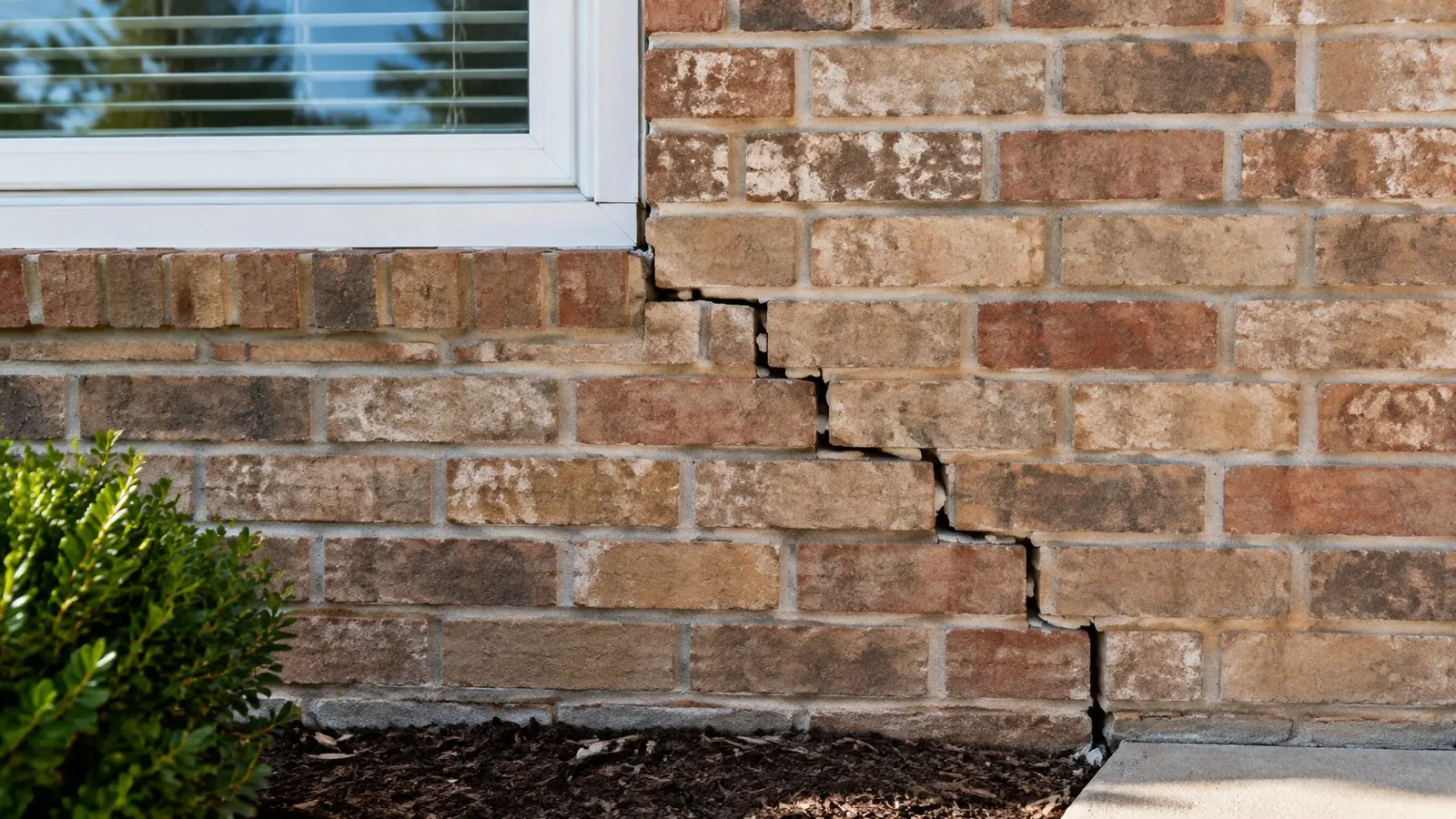
Patterns worth writing down
- A crack that climbs the brick like a staircase, following the mortar joints, often starting at the corner of a window or the garage opening.
- A crack that is clearly wider at one end than the other, which suggests one part of the wall has tipped away from the next.
- Diagonal cracks in drywall that leave the upper corner of a door or window and head for the ceiling.
- A fresh gap between the brick and a window frame, or between the top course of brick and the trim board under the eaves.
- A chimney or a front porch that has opened a gap where it meets the house.
Mark each end of a crack with a pencil line and the date. Photograph it with a coin beside it. If the crack grows past your marks over a season, you can say so with confidence when you call.
Ordinary causes that look similar
Heat and moisture in the brick
A long brick wall swells and shrinks with the weather. Without enough expansion joints it relieves the stress with a thin vertical crack, usually near a corner.
A rusting steel lintel
The steel angle that carries brick over a garage door or wide window can rust and swell. The brick above it cracks at the two upper corners of the opening.
Drywall joints
Taped seams crack as framing lumber dries and as attic heat moves the roof framing. These cracks tend to be straight and follow a sheet edge.
A new house settling in
In the first couple of years, concrete and lumber lose moisture. Small cracks from that period often stop growing by themselves.
What a foundation company looks at
- The width of each crack and whether the two faces are still flush with each other.
- Whether the cracks on different walls agree about which part of the house moved.
- Floor heights across the house, taken with a levelling instrument.
- Doors and windows near the cracks.
- Expansion joints, lintels and the mortar itself.
- The ground outside: slope, downspouts, large trees and how dry the beds are.
More on the visit itself is in the guide to a foundation inspection.
If the slab has moved
When the measurements show that an edge of the slab has dropped, a company may propose supporting that edge on piers and raising it. The repair methods guide describes the kinds of pier in plain words.
Brick is repointed and drywall is patched afterwards, once the house has had time to rest in its new position. Patching first, on a slab that is still moving, tends to reopen. Ask in writing which cosmetic repairs are part of the job and which are left to you.
Questions about cracks
Is a hairline crack in the mortar a foundation problem?
On its own, usually not. Thin cracks that stay the same width for years are common in brick veneer. A crack that widens, steps down the wall or comes with sticking doors nearby is the kind to have looked at.
Should I fill the cracks before someone comes out?
Leave them. An open crack can be measured and photographed, and its width is part of the record. Caulk and paint hide exactly what the person inspecting needs to see.
Will the cracks close when the house is raised?
Some close partly, some do not move at all, and a few new hairlines can appear as the frame adjusts. No company can promise how brick will behave, so ask what it will and will not repair afterwards.
When you are ready
Describe the problem and book an inspection
One call puts you in touch with an independent foundation repair company that works in Sugar Land. Have the address, the age of the house and a short list of what has changed.
Talk to a local foundation company
Say what you are seeing and where in the house. The company you reach is independent and gives you its own findings and its own price.
Call (832) 307-1056Read the referral disclosure and the privacy policy.